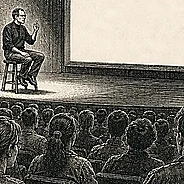


Preparation matters. Clarity matters. Respect for the audience matters.
One of the things I've learned over the years is that professionalism is surprisingly easy to recognize. It reveals itself in dozens of small ways: arriving on time, being prepared, understanding your audience, and respecting other people's time.
The hallmark of a professional presenter isn't making me think they're clever. It's making me think I'm clever because I actually understood whatever it was they were talking about. Unfortunately, it's equally easy to spot the absence of professionalism, as I was reminded only recently...
The call that went wrong
I just got off a disastrous conference call with representatives from a company who were hoping I’d write a column about them under my byline for publication on the prestigious EE Journal website.
When I say “disastrous,” I mean that it was disastrous for the company involved because it put me in a bad mood and made me wear my frowny face. Even worse (for them), I’m not going to be writing about them in the short term because I still don’t have a clue what they do. And I have little desire to re-engage with them in the long term because life is short, I’m feeling grumpy (as a result of the aforementioned call), and I have better things to do with my time.
Let’s take a step back. In this particular case, we are talking about a startup company that has only recently emerged from stealth mode. Our call had been scheduled a couple of weeks ago. Unfortunately, the person the company had chosen to speak with me—while undoubtedly very clever and knowledgeable—has not been blessed with the ability to articulate whatever information he wishes to impart.
Even worse, he had no materials to share, like PowerPoint slides or imagery that might have given me a clue as to what he was waffling about. I’m a control engineer by trade. I drifted into writing after publishing my first book, Bebop to the Boolean Boogie: An Unconventional Guide to Electronics. I jokingly describe myself as a techno-geek translator because I spend most of my time talking to other engineers about their esoteric technologies and then writing about them in words that everyone else can understand.
I flatter myself that I have at least a foundational understanding of a wide range of engineering, scientific, and technological disciplines. From one day to the next, I can find myself talking to people about artificial intelligence, augmented reality, neural networks, sensor fusion, gene editing, quantum computing, chiplets, fusion reactors, brain-computer interfaces, and the aerodynamic properties of custard.
I just threw the last one in to see if you were paying attention.
The point is that even when I don’t know much about something, I’m a quick learner. It also helps that I know lots of “pieces of the jigsaw,” allowing me to see how someone’s new technology fits into the “big picture” (I never metaphor I didn’t like).
In a crunchy nutshell, and without wishing to blow my own flügelhorn (once heard, never forgotten), if I can’t understand something after a one-on-one conversation with someone whose sole task is to explain it to me… then goodness only knows how they are going to fare with other members of the media, many of whom are less technically aware than your humble narrator (I pride myself on my humility).
Red flags in a media briefing request
Since we’re already here, let’s talk about some of the other things that rub me the wrong way when I’m being briefed by a company.
Remember that these calls are usually initiated by someone, internal or external to the company, who is providing (or not, as the case might be, and as we’ll see) PR and marketing support.
The date and time of the call may have been set up days or weeks in advance, thereby giving everyone time to prepare. In my case, I’ll spend some time perusing and pondering the company’s website, reviewing any supporting materials they’ve provided, and trying to form at least a vague idea of what they actually do.
The first red flag for me is when, just after the details of the call have been established, my contact asks, “Can you provide a list of questions for them to prepare for?” What? No! I don’t yet know enough about what they’re offering to know what questions to ask.
Another warning sign is when the call commences, and after we’ve all introduced ourselves, their lead says something like, “So, what do you want to talk about?” Wait! What? You’re the ones who requested this meeting in the first place, and you don’t know what we’re supposed to be talking about?
The publication test
One of my typical opening gambits, “A starter for 10 points,” if you will, is to say something like, “This is for a column for EE Journal. Are you familiar with this publication?” I’m obviously delighted if they respond, “Oh yes, I read all of your columns.” I’m more than happy if they say something like, “I wasn’t, but I spent some time investigating the site and its content before our call.” And you can only imagine my feelings if they reply, “No, I’m sorry, is it related to EE Times?”
At that point, I know two things. First, nobody has spent even five minutes researching the publication they asked to brief. Second, the odds of the rest of the meeting going well have just taken a dramatic turn for the worse. If they haven't bothered to research the audience (me, in this case), what are the chances they've prepared the presentation?
Now that I’ve started writing this, all sorts of briefing blunders and conference-call calamities are popping into (what I laughingly call) my mind. The warning signs tend to be remarkably consistent. Someone arrives late and everyone needs to introduce themselves again. The founder decides to "wing it." A supposedly quick demo wanders off into the weeds. A simple question triggers a five-minute answer. Two people from the company start talking over one another. Someone shares the wrong screen. And then comes the inevitable 150-slide deck...
What the good ones do differently
But it’s not all doom and gloom. There are some PR and marketing people who do things the right way. Once again, these could be internal or external to the organization. I’m not privy to all their cunning tricks, but some of the ones I do know are as follows:
- They brief the presenter on the publication they are poised to address, the required level of technical detail, and the marketing points to weave into the presentation.
- They brief the presenter on the media representative they’ll be meeting with (me, for example), and that person’s areas of interest and level of expertise.
- They work with the presenter on the slide deck. Bigger is rarely better, in this case. I’ve experienced disastrous presentations with 100+ slides and wonderful ones with only 4 or 5.
- They work with the presenter on their presentation (“Explain what all the acronyms mean, stick to what we rehearsed, and try smiling once in a while.”).
Great technology deserves great communication
At the end of the day, I’m not impressed when someone uses their presentation as a platform to convince me how clever they are, only to leave me wondering, “What the heck were we just talking about?” What does impress me is when someone who obviously knows their stuff explains things in such a way that leaves me thinking, “I must be cleverer than I thought because I actually understood that!”
Great technology deserves great communication. And this isn't only about media briefings. All the points discussed in this column are equally applicable whenever founders pitch customers, investors, strategic partners, prospective employees, or anyone else whose support they hope to win. Preparation matters. Clarity matters. Respect for the audience matters. These aren't journalism skills; they're professional skills. The founder who wings a briefing call is often the same founder who wings a customer presentation and then wonders why the deal never closed.
None of this happens by accident. It takes preparation, rehearsal, messaging, coaching, and people who understand how media, marketing, and perception actually work. The good PR and marketing professionals aren't there merely to "support" the presentation; in many cases, they are a major reason it succeeds.
So, for the love of Bog, people, practice your pitch!