Twelve Precepts of Standard Propaganda
The foundations are settled. Spend your mindshare on the product only you can build.

Third-Party Authority Beats Self-Claim.
Your champion does not forward your website. They forward the article their VP's peer mentioned.

On Easter Sunday 1929, Bernays paid a group of young women to march down Fifth Avenue smoking cigarettes in the parade. He did not announce it as an advertisement. He arranged for the press to cover it as a suffrage demonstration — Torches of Freedom. Cigarettes, rebranded as liberation, routed through the credibility of the women's rights movement. Overnight, people forwarded a product half the country had been told not to want. The carriers had no idea they carried an ad.
A hundred years of advertising research have failed to dislodge the mechanism. Your buyer's procurement committee does not care what your landing page says about you. They care what the Gartner analyst wrote. The Hacker News thread their staff engineer saw. The keynote at the trade show three of them attended. The peer at Boeing who mentioned you on a call. If the only person vouching for you is you, you lose to the incumbent the committee has already heard of.
The modern names for this law are social proof and third-party validation. A buying group weighs analyst relations, peer references, and independent reviews above anything a vendor says. B2B social proof is what the buying committee forwards, not what the vendor publishes. Deep tech startups that fund only self-published claims starve their own champions. Budget for the assets other people can cite. The market believes its own voices first.
Good marketing produces ammunition, not attention. Things your champion can forward in an email you will never see.
The work
Ammunition does not write itself.Somebody has to hold the pen.
Story Beats Spec.
Your technical buyer wants stories more than your non-technical buyer — because they are the ones who have to forward them upstairs.
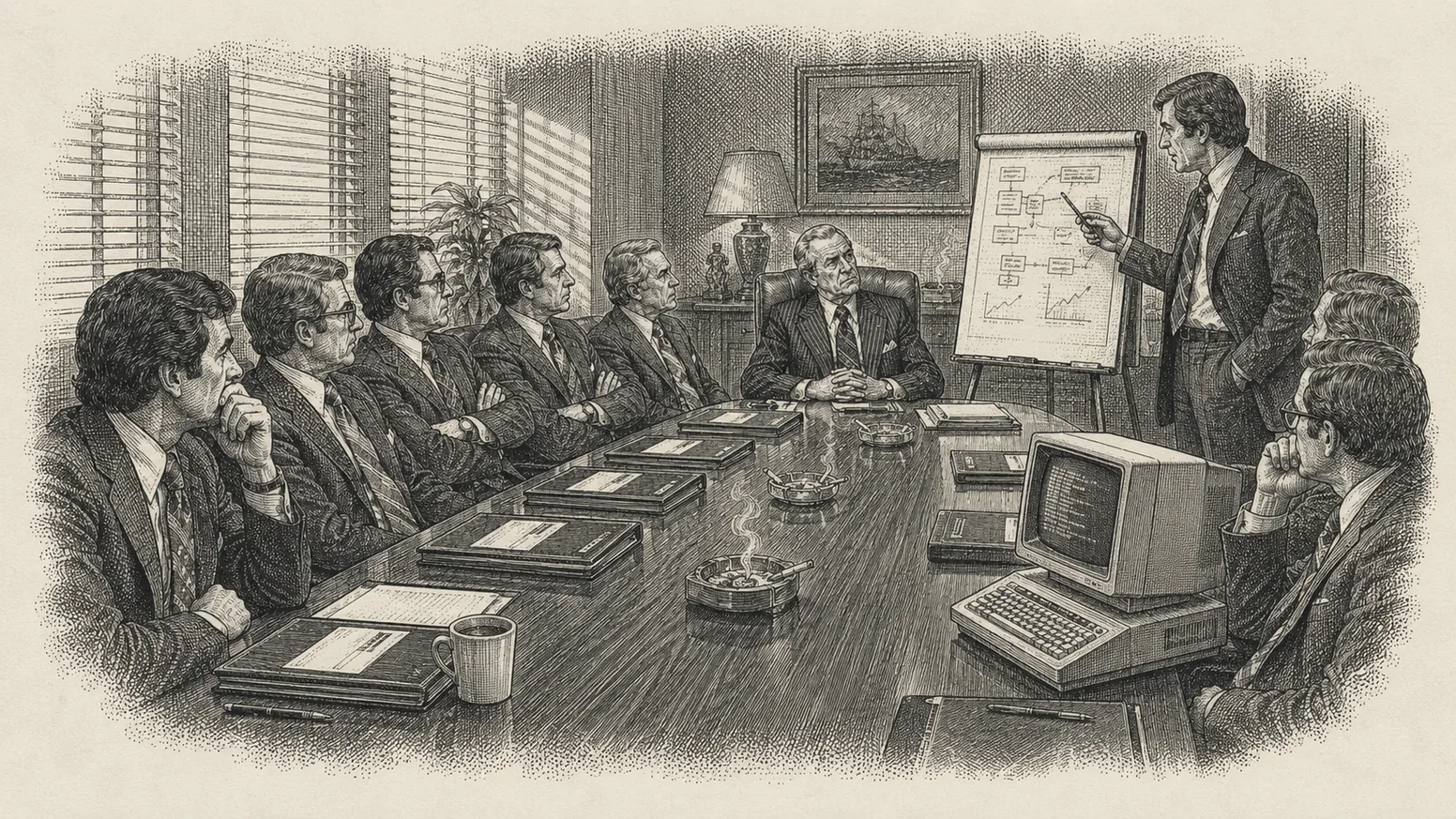
In 1982 IBM became the beneficiary of one of the most durable pieces of corporate mythology in enterprise history: Nobody ever got fired for buying IBM. It was never an advertisement. It was a story. The story protected IBM's enterprise base through three technology cycles better than any feature on any spec sheet. Ogilvy had proved the mechanism two decades earlier with "At 60 miles an hour the loudest noise in this new Rolls-Royce comes from the electric clock." One spec, rewritten as a story, moved more cars than the engineering ever could.
Deep tech founders believe that technical buyers want specs. They are wrong. Technical buyers want the story that makes the specs make sense — because that is the story they have to retell to the executive who controls the budget. A spec sheet cannot be forwarded up the chain. A story can.
This is the working law of B2B storytelling. A strategic narrative is not decoration on top of the technology. It is the format a buying group uses to move a decision through procurement. Your champion retells the story to the executive sponsor without you in the room, so write it to survive the retelling. In deep tech marketing, the story is the unit of transmission.
The buyer who cannot tell their boss a story about your product is the buyer whose deal dies in the committee.
The work
The spec is written.The story is not.
Perception Is the Product.
Two identical deep tech products convert at different rates based entirely on how the problem is framed.

In 1947, De Beers ran a campaign that turned a stone — not a rock, a stone — into the symbol of marital commitment. A Diamond Is Forever ran for seventy-five years. The carbon in the box never changed. The frame around it did. The frame was the product, and the frame built the most resilient category in consumer marketing history.
The same mechanism runs your market. A PCB tool with AI is a feature. An automation layer the incumbent cannot build is a market — identical engineering, different perception. Reframe what your product is for and the buyer sees a different thing. Different category, different budget, different urgency.
This is why positioning work starts with perceived value, not the feature list. A value proposition is a frame. Brand positioning tells the buyer which market category to judge you in, and the category sets the budget line, the urgency, and the alternatives. Perception is not the enemy of technical truth. It is the path technical truth takes to a purchase order.
This is not trickery. It is how human evaluation has always worked, and pretending otherwise costs you deals you should have won on merit. The object in the box is not the product. What the buyer can defend internally is the product.
The work
Framing is not a taste question.Somebody has to own it.
Scarcity Creates Demand.
Your instinct to open access to everyone is what tells enterprise you are not worth the effort of evaluating.

In the early 2010s, Nvidia kept a tight hand on CUDA developer access — qualified programs, certified partner tiers, hardware kits you had to earn. The scarcity was not about cost. It was about signal. The engineers who got in believed they had joined something. The companies that certified advertised the fact. A generation of AI infrastructure grew inside a velvet rope Nvidia engineered before the market knew it wanted in.
Cisco did the same thing with the CCIE certification program in 1993. Artificial credential scarcity turned network engineering into a club, and having a CCIE on staff became the proof that a company was serious about its infrastructure. The certification was the marketing. The scarcity was the point.
Scarcity marketing is not a consumer trick — in enterprise software and hardware, access is pricing strategy. A design partner earns a seat. A beta program qualifies its entrants. An early access program keeps a list. Each closed door tells the market your product deserves evaluation, and exclusivity signals value the same way a price does. Design the door before you open it.
Deep tech founders reflexively open the door. Free trials, open source everything, a "book a demo" button on every page. This reads as generosity to the founder. It reads as unqualified to the enterprise buyer. A scarce thing demands evaluation. An abundant thing is a feature request. If access is free, the buyer calibrates your value at free.
End of Volume One — Of the Market
Four laws about a market that has not heard of you.None of them run themselves.
Why Beats What.
Get this right and the rest is a matter of execution. Get it wrong and no feature will save you.

Intel was a memory company through the 1970s. By 1984, Japanese DRAM competitors had driven their margins to zero. Andy Grove and Gordon Moore did the thing most founders cannot do: they killed the product the company had been built around. Intel exited memory and became a microprocessor company. What survived the transition was not the what. It was the why Moore and Noyce had written down in 1968 — be the first to make the next generation of semiconductor technology possible. Memory was how they lived that why in the 70s. Microprocessors were how they lived it after 1985. The product changed; the why did not. Intel compounded for forty more years on that continuity.
Features decay. Benchmarks get matched. The incumbent ships your headline feature in the next release. What does not decay is the reason you built the product in the first place — the thing your engineers believe, the hill your founder will die on. Your why is the only thing in your company your competitor cannot copy.
But the deeper move is this: your why is the filter that decides which buyers you should even be fighting for. A buyer whose mission aligns with yours will choose you over a better-featured competitor, because the competitor is selling the right product to someone else. A buyer whose mission does not align will leave you for a better spec sheet the moment one arrives.
A company mission is not a poster. It is a filter that selects the buyers, the hires, and the categories where you can win. This is also why founder-led sales works: the founder carries the why with the least translation loss. Products change on a roadmap. The why compounds across decades.
Your competitor's feature list is only a threat if you are fighting for the same buyers. Why tells you which buyers are yours.
The work
The why does not survive on its own.It has to be maintained.
Position Against the Right Alternative.
If you do not choose the category, your buyer will — and they will pick the one where you look worst.

In 1999 Salesforce launched a CRM product in a market Siebel had already won. Benioff could have competed on features, integrations, and price. He competed on category instead. He branded the entire company as "No Software." He picketed Siebel's user conference with protest signs and refused the axes Siebel had defined. Same market, different fight, different outcome — a multibillion-dollar business built on the refusal of the frame.
In deep tech this gets decided in the first thirty seconds of a buyer's internal conversation. "Another PCB tool" loses to Altium before you are in the room. "The automation layer Altium cannot build" does not. The incumbent wins the comparison you allowed them to set. Your only move is to set a different one.
This is competitive positioning in one move: choose the alternative you are judged against. A positioning strategy that never names the real alternative leaves the choice to the buyer, and the buyer defaults to the incumbent. A positioning statement is where you write that choice down. Category design is the deliberate version of the same act. Every competitor comparison happens inside a frame someone picked. Pick the comparison you can win and refuse the one you cannot.
Positioning is not what you say. It is which fight you picked.
The work
Your buyer will choose the category.Unless somebody chooses it first.
Buyers Hire Products to Make Progress.
Nobody in your buyer's organization wakes up wanting to buy software. They wake up needing to make something move forward.

Christensen and Moesta formalized it in the 2000s; the underlying observation is as old as trade itself. Your buyer is not looking for a product. They are looking for a way to make something progress — a tapeout that is stuck, a compliance gate they need to clear, a budget cycle they need to survive. The product is the tool. The progress is the purchase.
Four forces govern every switch: push from the current situation, pull of the new, anxiety about changing, inertia of habit. Deep tech founders over-index on pull (features) and under-index on anxiety (switching costs, compliance risk, retraining). The deals that stall in pilot stall because the anxiety forces were stronger than the pull forces, and nobody ran the math.
The jobs to be done framework reads every purchase as a hire for progress. JTBD reads every stalled deal as a fight between pull and anxiety. Switching costs, compliance risk, and retraining are the hidden half of the B2B buyer journey. Map the four forces for your beachhead market before you write another feature page. The math decides the deal.
Your pilot did not stall because your product was inadequate. It stalled because you sold pull and your buyer was priced in anxiety. Run the math on both forces or keep losing deals you thought you had won.
The work
The progress is not in the feature list.Somebody has to go and find it.
Pragmatists Do Not Buy From Visionaries.
The CTO who bought your first version is not the committee that will approve the next nine.

Moore named it in 1991; enterprise buying had known it for a generation. The first customers of a new category are the risk-seekers. The volume of a mature market is in the risk-minimizers. The message that won the first ten deals will fail at the eleventh — because the eleventh buyer does not care about your vision. They care about whether anyone like them has done this before.
Deep tech founders confuse early enthusiasm with product-market fit. The visionary CTO who bought on Friday is not the committee that approves the next nine purchases. That committee needs logos, precedent, peer references — and no amount of founder passion will substitute for them.
Moore called it crossing the chasm, and the technology adoption lifecycle still governs enterprise markets. Early adopters buy vision. The early majority — the pragmatists — buy precedent. A beachhead market exists to manufacture that precedent one narrow segment at a time. The beachhead strategy is patience with a map: win the segment completely, then let the references sell the next one.
Pick a beachhead narrow enough that you can deliver the complete solution. Let that segment become the precedent for the next.
End of Volume Two — Of the Position
Position is the one thing no tool will do for you.It is also the thing nobody owns.
Start With the Buyer's Experience.
What you built is not what the buyer sees. What the buyer can defend internally is what they buy.
Jobs stated it on record in 1997: start with the customer experience, work backward to the technology. The principle predates him by decades — every serious advertising mind from Ogilvy to Bernays insisted on it — he simply said it most forcefully. It is still the principle most often violated by technical founders.
Your pitch deck leads with your architecture. Your buyer reads it through the frame of their Tuesday morning. The VP will ask about references. The security team will block procurement. The CFO will question the category spend. Every word in your marketing has to survive that frame before it reaches the engineer who cares about your architecture.
This is buyer experience as a design discipline. Working backward starts from the moment of purchase and designs every artifact toward it — the deck, the demo, the pricing page, the security review. Product marketing that starts from the architecture produces documentation. Product marketing that starts from the buyer produces decisions. Order of operations is the discipline.
Start at the end. Work backward to the technology. The order is not a preference. It is the work.
The work
The buyer’s side of the table is empty.Somebody has to sit there.
Change the Frame Before Arguing Inside It.
If the conversation is losing, do not argue harder. Argue somewhere else.
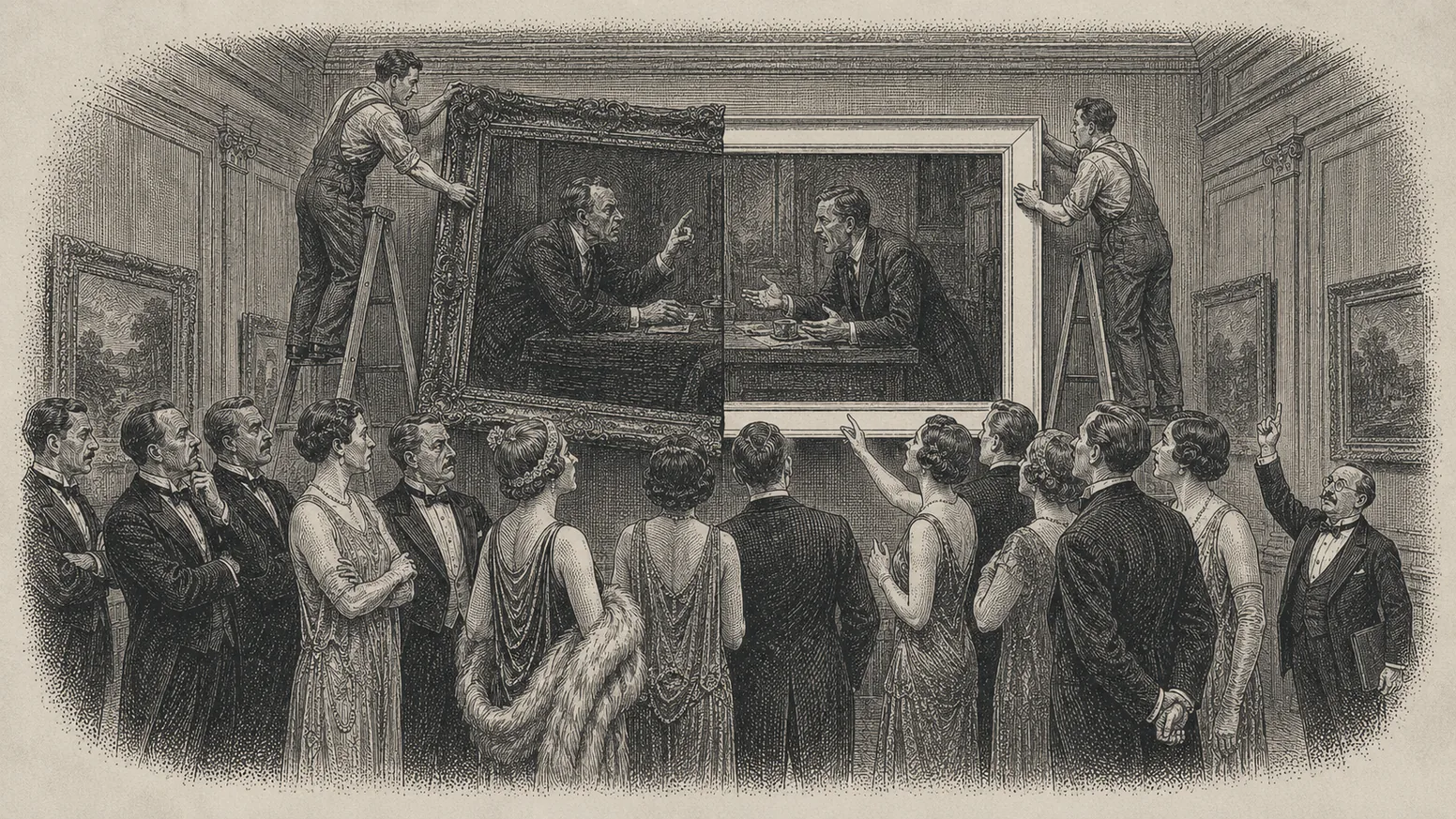
Every master of persuasion from Bernays forward operated on this principle. When the question is "why should we buy from a startup over the incumbent," you lose. Inside that frame the incumbent is the safer choice, and it always will be. When the question becomes "why is the incumbent's architecture the reason we are stuck," the frame has moved. You are winning before you have answered.
Deep tech founders lose this one constantly. A buyer raises an objection; the founder tries to answer it inside the frame the objection was raised in. The objection was the frame. The frame was the loss.
In sales conversations this is the difference between objection handling and frame control. An objection answered inside the buyer's frame confirms the frame. Reframing moves the conversation to ground where your architecture is the answer, not the argument. The discipline is to hear every objection as a frame, then decide whether to accept it.
Do not argue against the objection. Change what the objection is about.
The work
Reframing is a campaign.Not a sentence.
Proof Not Hype.
Your buyer has trained themselves to delete adjectives on sight.
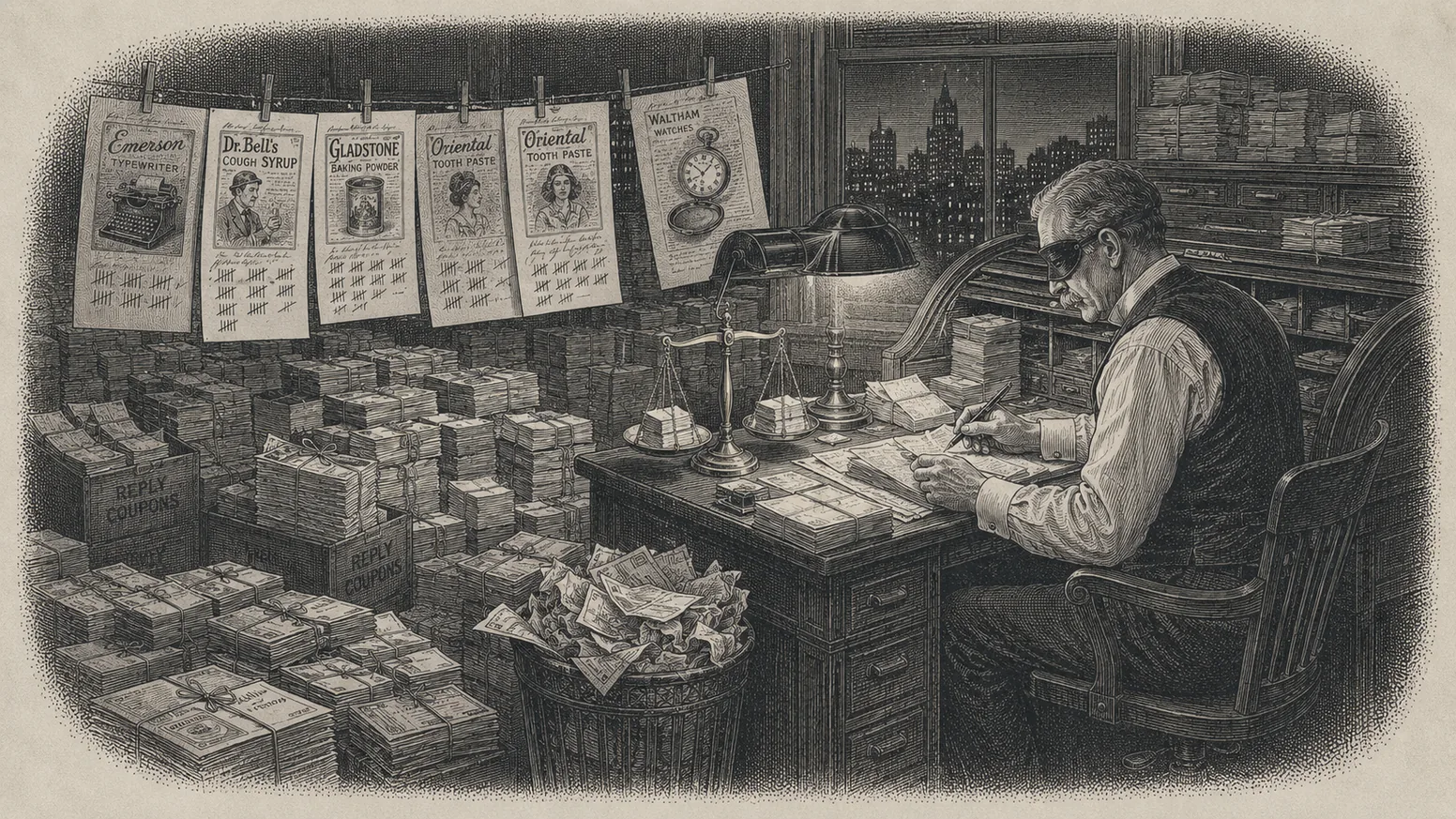
Claude Hopkins published Scientific Advertising in 1923. Every claim tested. Every headline earned. Every word subjected to proof. A century later it is still the discipline — and the discipline most founders skip.
Your product is not being ignored because it is bad. Your buyer has watched five years of vendors promise transformation and deliver PowerPoint. Adjectives get deleted. Benchmarks do not. Named customers do not. A technical brief their VP can defend in a meeting survives.
This is evidence-based marketing as a daily practice. Proof points are the currency: benchmarks, named case studies, reference customers, numbers a champion can defend. Proof of value is the enterprise version of the same discipline, run inside the deal. A claims audit is simple — delete every sentence your buyer cannot verify, then count what survives. What survives is your marketing. Everything else was hype.
The discipline is not saying less. It is earning every word you say.
The work
Proof is gathered, not written.Which makes it a job.
Repetition Earns Belief.
Your name has to appear in three evaluation calls, four internal emails, and two conference mentions before procurement will entertain you.
Aristotle named it. Hopkins measured it. Every piece of advertising research since has confirmed it. Familiarity compounds into trust because belief is an efficient shortcut, not because buyers are gullible. When a claim appears often enough from enough sources, the cost of disbelieving it exceeds the cost of entertaining it. This is how enterprise buying has always run.
Deep tech founders interpret this as a mandate to run more ads. It is not. It is a mandate to run the same message, consistently, in enough places that it becomes ambient. One idea, repeated. Not twelve ideas, each once. The founders who win are the ones whose name the buyer was already tired of hearing before the first meeting.
Media planners call it effective frequency. Strategists call it share of voice. The mechanism is the same: brand awareness in B2B compounds through brand consistency, not variety. A messaging framework exists to make consistent messaging cheap to repeat. One positioning, one enemy, one story — repeated across every channel the buying committee touches. Repetition is not a budget line — it is the strategy.
The first time a buyer hears your name, they forget it. The seventh time, they remember. The twelfth, they mention you to procurement on their own.
The work
This is won in week fourteen.Long after you are bored of it.

The foundations were solved a hundred years ago.


Running experiments to rediscover what marketing already knows is like running experiments to measure gravity. You did that in high school. The number has not changed since. Once you understand the law, adjust for where you are. Earth. Moon. Mars. Same law. Different gravity.

The winners wore this path down.You were taught to avoid it.
Not out of ignorance. Founders are told to challenge every assumption — which is exactly right in the part you are inventing, and a category error where the answer was settled a century before you arrived. A hire takes four months to recruit. An agency is never on the call.
Then whose job is it?
SERVICES →

Schedule Consultation